
A tank water heater costs less to put in and is simple to replace like for like. A tankless water heater costs more up front but uses less energy, lasts longer and never runs out of hot water mid-shower. The right pick for your Orange County home depends on how much hot water you use at once, your gas line and vent, and how long you plan to stay.
Below, our family-owned team walks through each point the way we do on a free phone quote, so you can decide before anything is booked.
How Each Type Heats Water
A tank water heater keeps 40 to 50 gallons (or more) of water hot all day in an insulated tank. When you open a hot tap, hot water leaves the top of the tank and cold water refills the bottom. Once the tank is used up, you wait while it heats a fresh batch.
A tankless water heater has no storage. Water flows through a heat exchanger and a gas burner or electric element heats it only while a tap is open. Turn the tap off, and the unit shuts down. You get a steady stream of hot water as long as you don't ask for more than the unit can heat at one time.
That one difference drives almost everything else on this page: cost, energy use, upkeep and how the system feels day to day.
Tank vs Tankless: Side by Side
| Feature | Tank | Tankless |
|---|---|---|
| Upfront cost | Lower | Higher, often with gas, vent or electrical changes |
| Energy use | Heats water around the clock | Heats water only on demand |
| Typical life | About 10 to 15 years | Can last more than 20 years |
| Hot water supply | Runs out when the tank is empty | Steady, up to the unit's flow limit |
| Space | Floor space in a garage or closet | Small box on a wall, inside or outside |
| Hard water upkeep | Flush sediment from the tank | Descale the heat exchanger |
| Swap time | About 3 to 5 hours, same type | Often a full day or more when switching |
The lifespan figures come from the U.S. Department of Energy. Its Energy Saver guide says most storage water heaters last 10 to 15 years, while tankless water heaters can last more than 20 years.
Which Costs Less Up Front, and Which Saves More Over Time?
A tank water heater almost always costs less on install day. If your old tank sits in the garage and the new one is the same type and size, the job is mostly a swap: drain, disconnect, set the new tank, strap it and test it.
A tankless water heater costs more to buy and more to install. In many Anaheim and Orange homes built decades ago, the gas line to the heater was sized for a tank. A high-output gas tankless unit may need a larger line run to it, a new vent and an electrical outlet for its controls. Those changes are where most of the extra cost comes from.
The payback is on your gas bill. According to the Department of Energy's Energy Saver guide, homes that use 41 gallons or less of hot water a day can see a gas tankless heater run 24% to 34% more efficiently than a conventional storage tank. Homes that use a lot of hot water, around 86 gallons a day, see 8% to 14%. A tank keeps reheating the same water all night while you sleep. A tankless unit does not.
So the honest answer is: tank wins on day one, tankless tends to win over the years, and the longer you stay in the house the more that matters. We can't quote a price without seeing your setup, but we explain each cost factor on the phone so nothing comes as a surprise.
Will a Tankless Heater Keep Up With My Family?
This is the question that matters most, and it is where a poorly sized tankless unit lets people down.
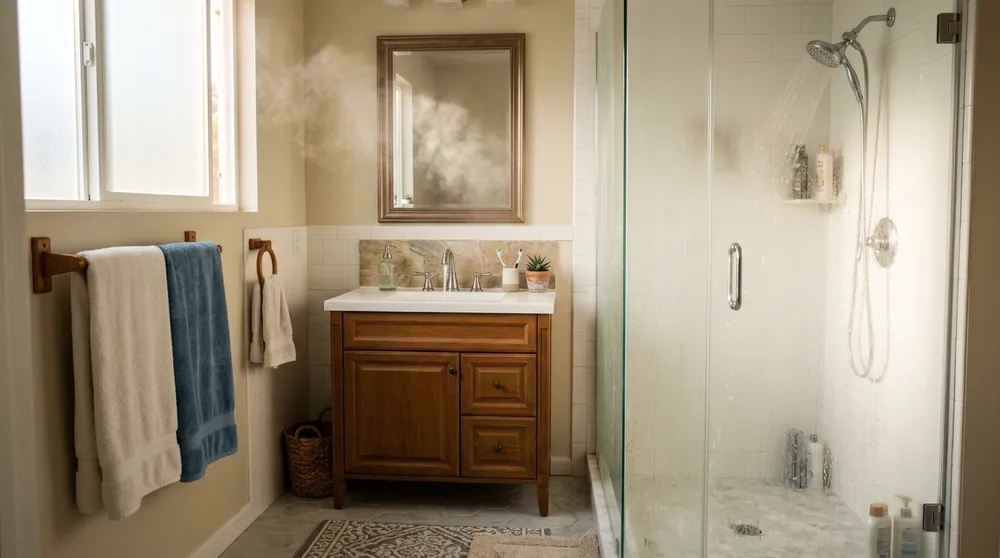
A tank holds a fixed amount of hot water. Two showers back to back plus a load of laundry can drain it, and the third person in line gets a cold rinse.
A tankless unit never "runs out," but it can only heat so many gallons per minute. If two showers, the dishwasher and the washing machine all call for hot water at once, a small unit may not keep up and the water turns lukewarm. The Department of Energy notes that homes using hot water in several places at once may need two or more tankless heaters.
When we size a tankless unit, we ask:
- How many bathrooms do you have, and how many people shower in the morning rush?
- Do you run the dishwasher or washing machine while someone showers?
- Do you have a large soaking tub that needs a lot of hot water fast?
A single tankless heater is plenty for many Orange County homes. A big household with three or more bathrooms may be better served by a larger unit, two units, or simply a new tank.
Hard Water in Orange County: Upkeep for Each Type
Tap water across most of Orange County is hard. It carries calcium and magnesium that settle out when water is heated.
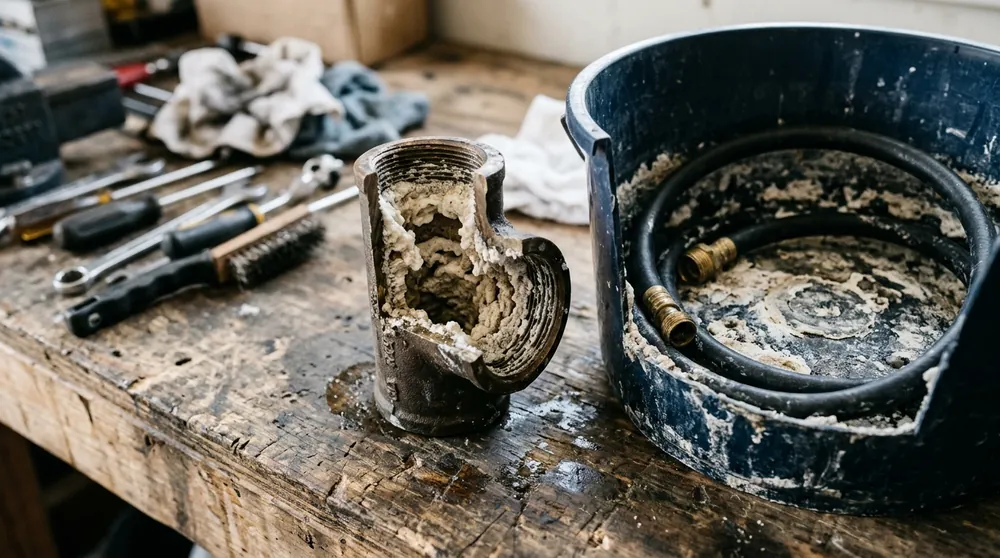
In a tank, those minerals sink to the bottom as sediment. You hear it as rumbling or popping when the burner runs. The sediment also makes the burner work harder and can shorten the tank's life. Flushing the tank helps when the buildup is light.
In a tankless unit, the minerals coat the inside of the heat exchanger as scale. Left alone, scale cuts the flow and can trigger error codes. The fix is regular descaling, a flush that runs a cleaning solution through the unit. In hard water, plan on it as routine care, not an extra.
Neither type is free of upkeep here. The work is just different. If you already have a whole-house water softener, both types last longer and need less attention.
Space, Venting and Where the Heater Goes
Many older homes in Orange, Tustin and Anaheim keep the water heater in a tight garage corner or a hall closet. A tank takes up that floor space and must be strapped against earthquakes, as California requires for every water heater.
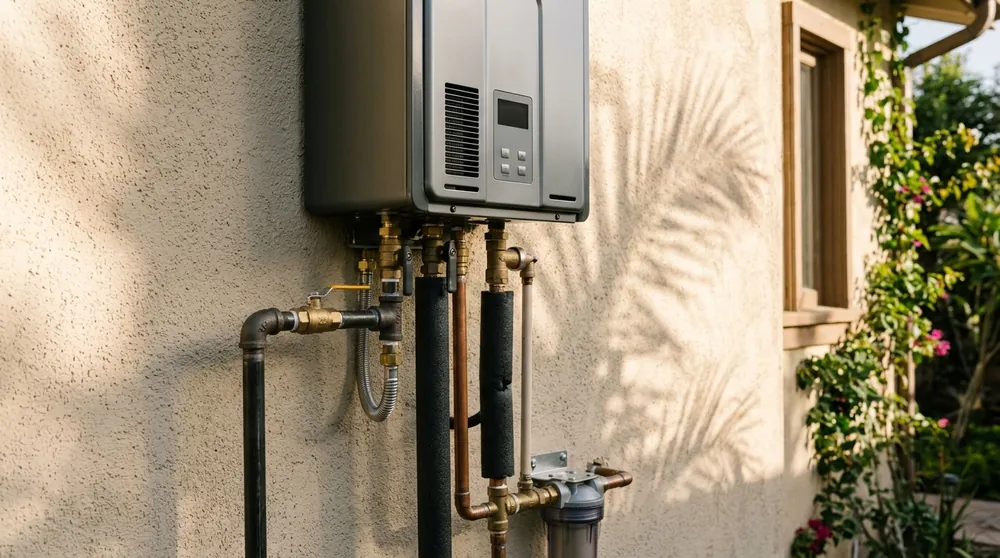
A tankless unit is about the size of a carry-on bag and hangs on a wall. In our mild Southern California climate, outdoor models mounted on an exterior wall are common, which frees up the closet or garage space entirely. The catch is that a gas tankless unit needs the right vent and clearance, and moving the heater to a new spot means running new water and gas lines to it.
Switching from tank to tankless is often a full day of work or more, because of those gas, vent and electrical changes. Replacing a tank with another tank is usually done in about 3 to 5 hours.
When a Tank Is the Better Pick
A new tank water heater makes good sense when:
- You plan to sell in the next few years and want the lowest cost today.
- Your household uses a lot of hot water at the same time and you don't want to add a second tankless unit.
- Your gas line or vent would need major work to support a tankless unit.
- The existing tank failed suddenly and you need hot water back with the simplest job.
When Tankless Is Worth It
A tankless water heater tends to pay off when:
- You plan to stay in the home for many years and want the longer life.
- Your hot water use is moderate, so the energy savings are at the high end.
- You want the floor space back in a small garage or closet.
- You are tired of running out of hot water after the second shower.
Tank or Tankless: Questions to Ask Before You Decide
Before you pick, have these answers ready. They are the same questions we ask on the phone:
- How old is your current heater, and is it gas or electric?
- Where is it now: garage, closet, attic or outside?
- How many people live in the home, and how many bathrooms do you have?
- Has anyone told you your gas line is undersized, or has a past heater had venting problems?
- Do you have a water softener?
With those details, we can tell you whether a tank, a tankless unit or a repair on your current heater makes the most sense. Sometimes the answer is that your tank only needs a new part, and we say so.
Talk It Through With a Local Plumber
Orange Independent Plumbing Services repairs, replaces and installs both tank and tankless water heaters across Orange County, with a focus on Anaheim, Orange and Tustin, and in the Central Valley from Bakersfield to Fresno. We are family-owned since 2015 and licensed and bonded under California license C-36 #1005919. Military and law enforcement households get 10% off.
See our tank and tankless water heater services, or if you live in Anaheim, our water heater installation in Anaheim page. Then contact us and describe your current heater for a free phone quote.